
What is Career Pathing?
Career Pathing at Raise is a clear yet flexible way for teammates to understand how they can grow, contribute, and build a meaningful career over time. It provides transparency into how roles connect and evolve, and what skills, behaviors, and impact are expected at each stage.
Career pathing is about growth, not just titles.
It helps teammates understand how to build mastery, expand impact, and contribute meaningfully, whether that growth is vertical, lateral, or both. Career Pathing is supported and sustained through the RAP practice. You can use the RAP to create a regular rhythm for reflection, alignment, and planning, ensuring career growth is intentional rather than reactive. Through RAP conversations, teammates step back to assess what they are learning, how they are showing up, and where they want to focus their growth next.
How Growth Works at Raise

Career pathing is not a one-time plan or a static document. It is an ongoing conversation that evolves as teammates, teams, and Raise grow. Regular check ins, feedback, and development conversations help ensure individual growth stays aligned with Raise’s purpose and priorities.
Career Pathing Is Self-Directed
Much like everything else at Raise, Career Pathing is a self-directed process. Each teammate is responsible for reflecting on their goals, strengths, and interests, and for bringing their perspective into development conversations. This includes seeking feedback, pursuing learning opportunities, and making intentional choices about how to grow.
Career pathing is rooted in Stewardship, Working Out Loud and Own Your Own Perspective, two core principles of the Raise OS. Together, they reinforce that growth requires both ownership of self and care for the broader system.

What this means in practice:
- Teammates own their engagement, impact, and development
- Career pathing is something you actively participate in, not something that happens to you
- Growth starts with self knowledge, self awareness, and personal accountability
Developing self-knowledge includes understanding your biases and patterns. If you have not yet explored self-knowledge tools such as the Shared Expectations, TRAITS assessment, Enneagram, or EQI, those are good places to start before diving deeper into Career Pathing.
Stewardship reminds us that career growth is not only about individual advancement. It is about building capability and capacity for our teams and for Raise as a whole.
The RAP is a Career Pathing Tool
The Role Advice Process is one of the most important tools for Career Pathing at Raise. The RAP was created for those times when you’re curious about how a role change could increase your impact, engagement, or meaningful work. It’s also useful to gain clarity when you’ve grown in your role, or your role has evolved. Additionally, you can use the RAP to chart your future growth. Where do you want to grow? Where do you want to go?
How to Use the RAP for Career Pathing
During your RAP, use the time to focus not only on work outcomes, but also on growth and development.
Consider bringing:
- Reflections on how you are progressing within your current role or belt
- Examples of where you demonstrated ownership, judgment, or influence
- Feedback you have received or are seeking
- Clearly identify and articulate what your future career goals are
- Invite advisors who can mentor you, and include a mentorship plan in your RAP Proposal
- Include questions about growth, scope, or next steps
RAP is an opportunity to Self-Manage, Work Out Loud and Own Your Perspective by clearly articulating what you are learning, where you are stretching, and how you want to continue building impact.
How the Raise Belt System Supports Career Pathing
Career pathing at Raise is brought to life through the Raise Belt System. The Belt System provides a shared, role agnostic framework for understanding growth and mastery across the organization.
Belts represent stages of mastery, not promotions.
Progression is defined by increasing skill, judgment, ownership, and influence over time.
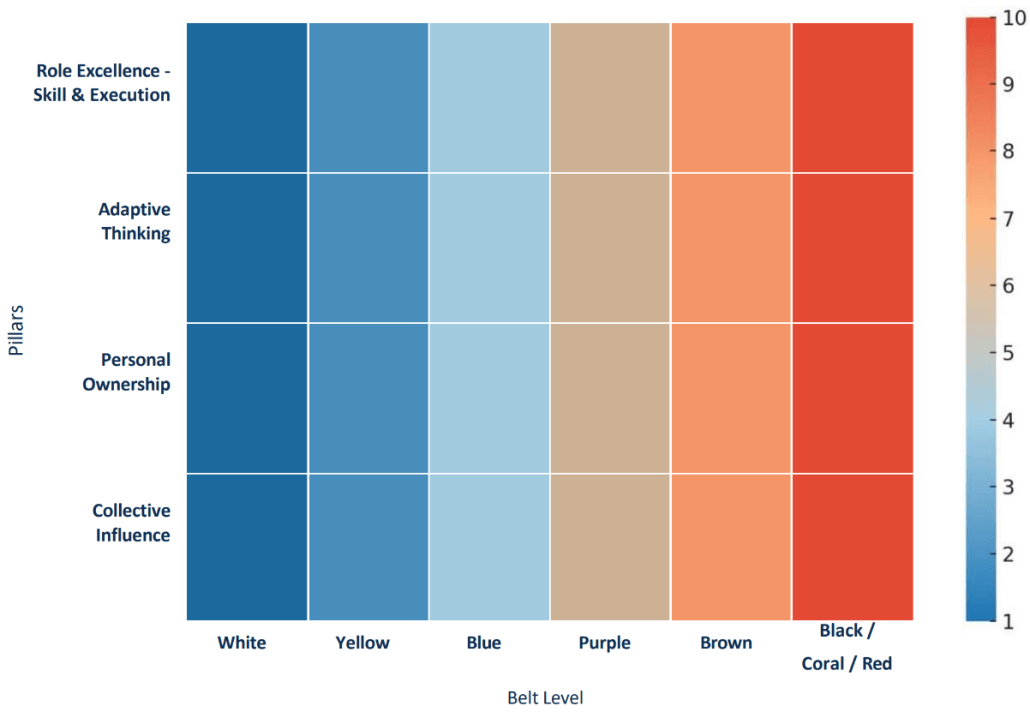
The Four Pillars of the Raise Belt System
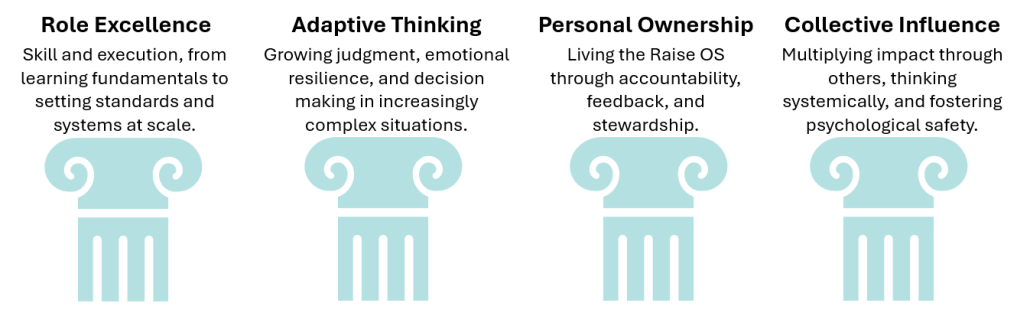
As teammates move through the Belt System, leadership influence increases alongside scope and responsibility. Career pathing uses the Belt framework to clarify expectations, support self directed development, and align individual growth with Raise’s long term needs.
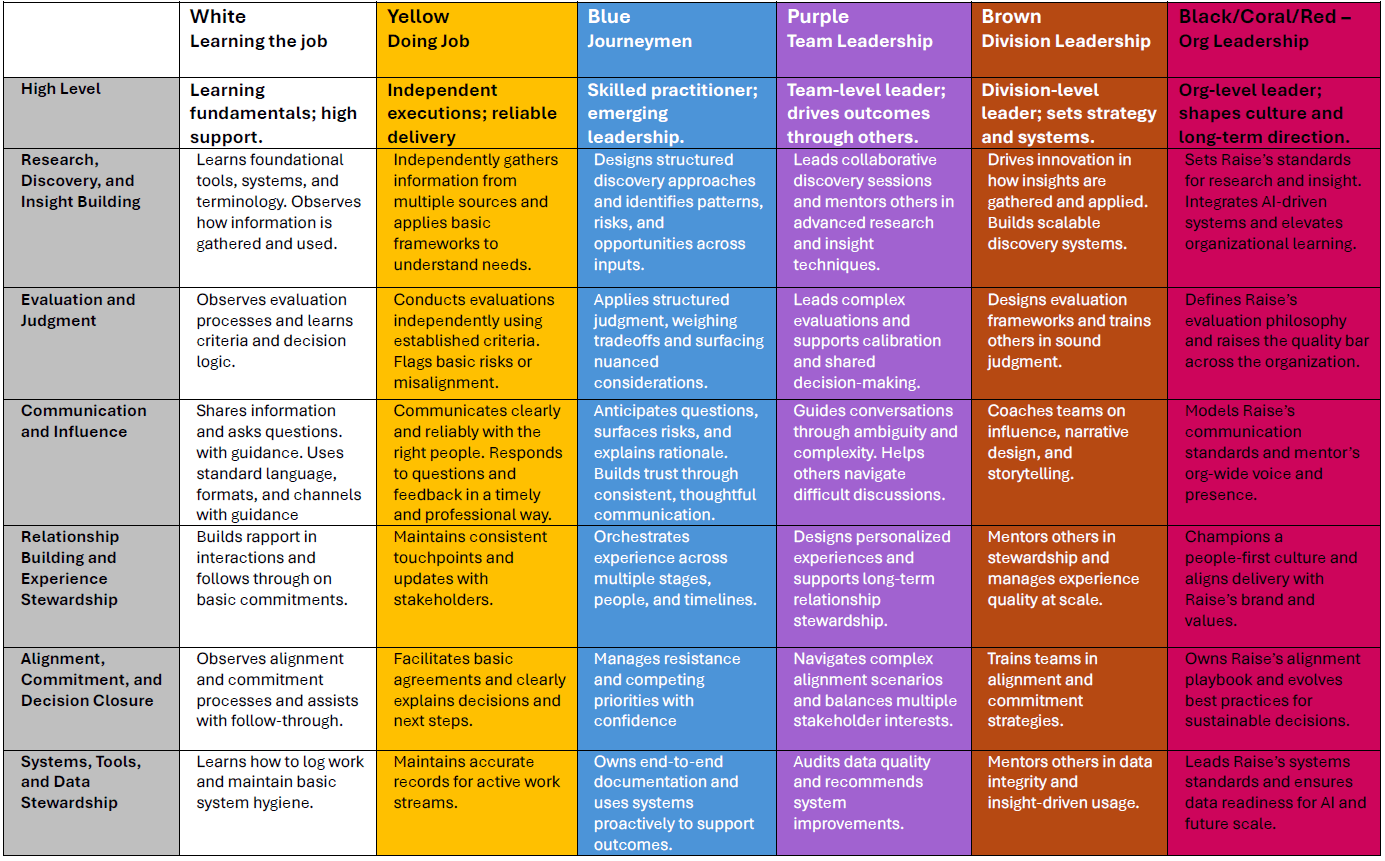
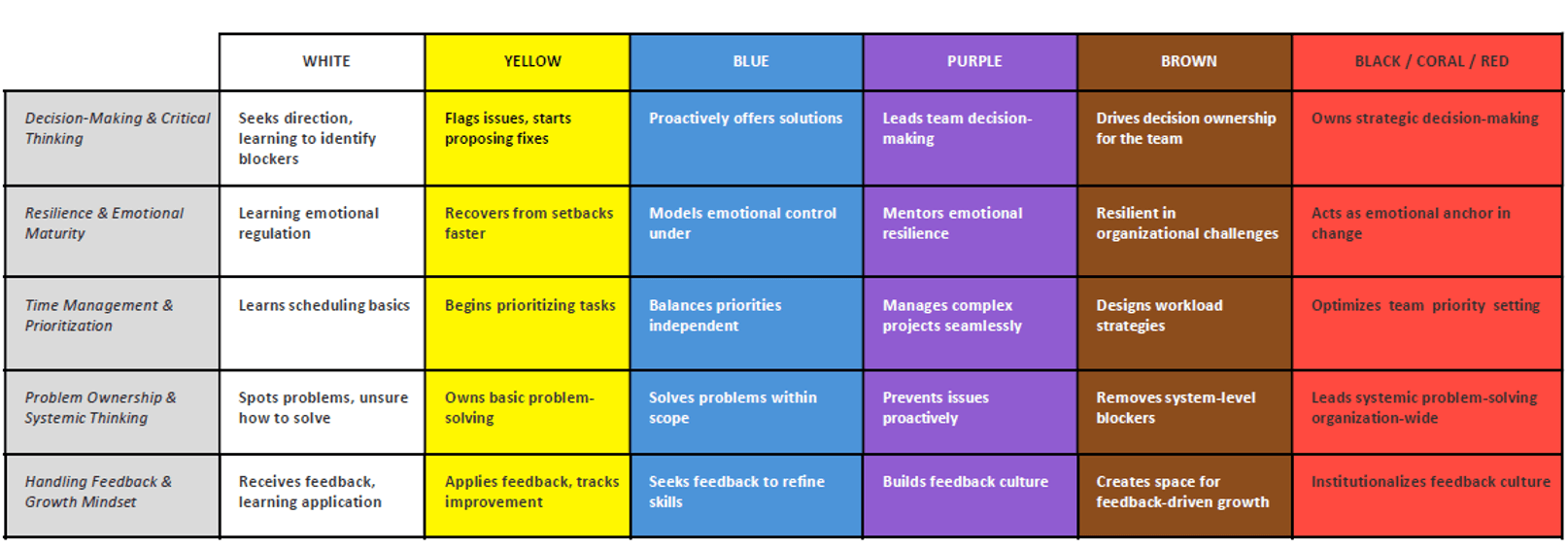
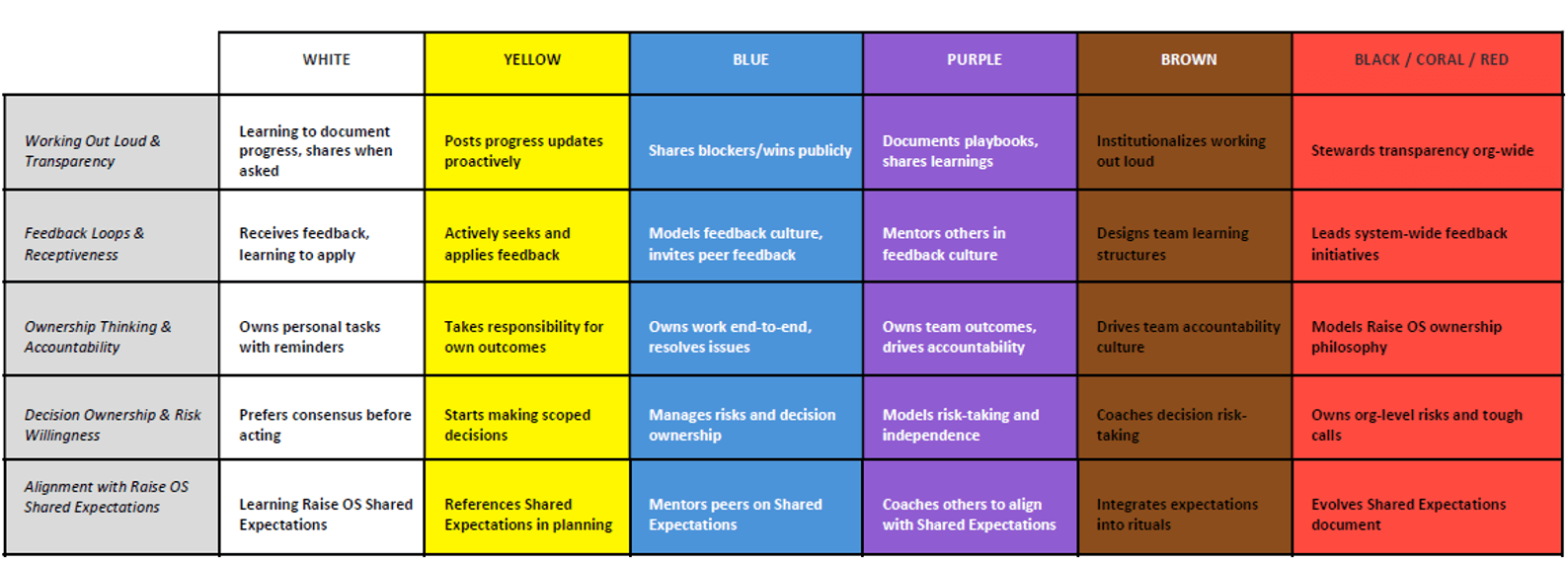
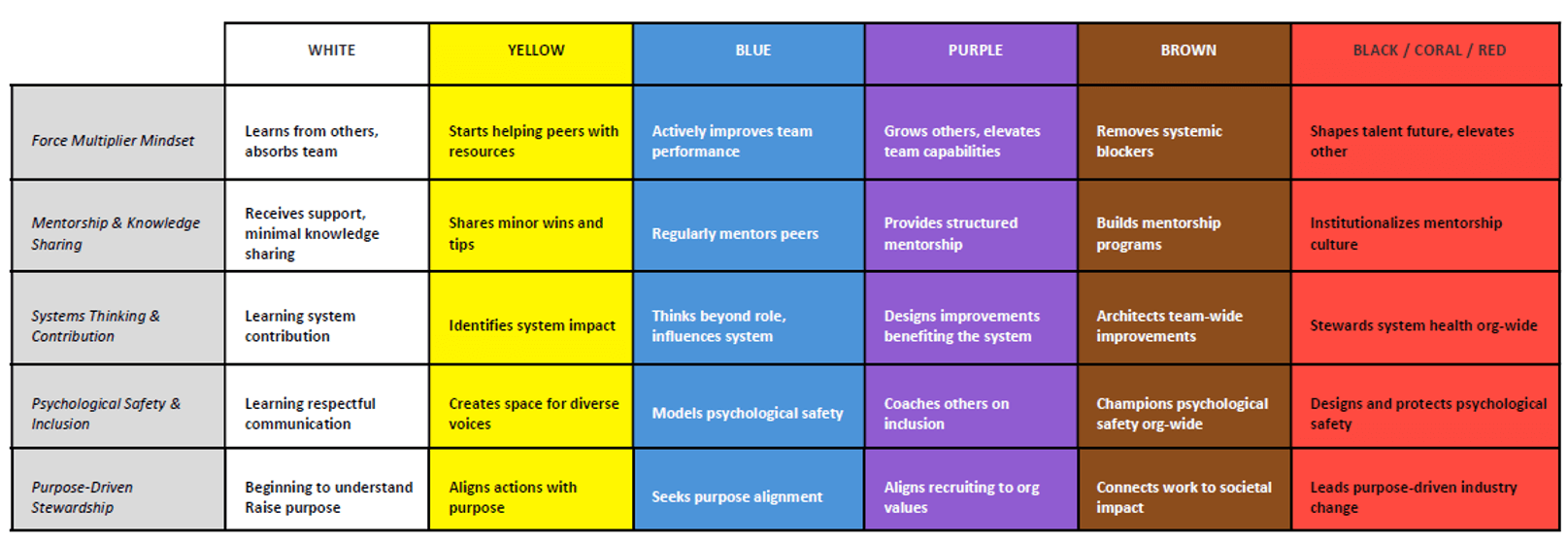
The Belt Matrices
The Raise Belt System progression reflects increasing mastery, skill, behavior, and impact not time or tenure. Each stage represents growth across all four pillars of the framework.
White → Yellow → Blue → Purple → Brown → Black /Coral / Red
- White: Foundations & Learning
- Yellow: Gaining Independence
- Blue: Operating with Confidence
- Purple: End to End Ownership
- Brown: Strategic Leadership
- Black / Coral / Red: System-Level Impact & Stewardship
Career Pathing Resources
At Raise, decision making is about more than choosing an answer. It reflects how ownership, judgment, and initiative grow over time. The Decision-Making Ownership Spectrum provides a shared language for how teammates engage with problems and take responsibility for outcomes.
This spectrum represents progression, not performance. Teammates may operate at different levels depending on context, experience, and complexity. This framework clarifies what ownership looks like at different stages of growth. As skills and confidence increase, expectations move from awareness and escalation toward initiative, accountability, and leadership.
Use this spectrum as a reflection and development tool. It can help you assess how you approach decisions today, identify where you are stretching, and clarify what greater ownership could look like in your role.
Level 1 – Passive Awareness
- “Is there a problem?”
- Example: “I’m not sure if there’s a problem or not.”
- Skills: Observation, curiosity
Level 2 – Problem Identification
- “There is a problem.”
- Example: “Something’s wrong here.”
- Skills: Awareness, risk-spotting
Level 3 – Options Thinking
- “There is a problem and here are some possible solutions.”
- Example: “We could try A, B, or C.”
- Skills: Critical thinking, analysis, creativity
Level 4 – Solution Ownership
- “There is a problem, and here is the solution.”
- Example: “I’ve thought it through — here’s the plan.”
- Skills: Decision-making, accountability
Level 5 – Proactive Action
- “There was a problem, and I fixed it.”
- Example: “I saw the issue, handled it, and here’s what I did.”
- Skills: Initiative, autonomy, leadership