

Pay or Payband Transparency?
What are my options?
You can opt-in to Payband or Pay Transparency.
What’s the difference?
Payband Transparency – This means your current payband will be visible in an All Company Database. This promotes company-wide pay equity and transparency.
Pay Transparency – This means your current salary will be visible in a Private Database accessible only to employees who have opted into full pay transparency. This supports deeper transparency and informed conversations around compensation.
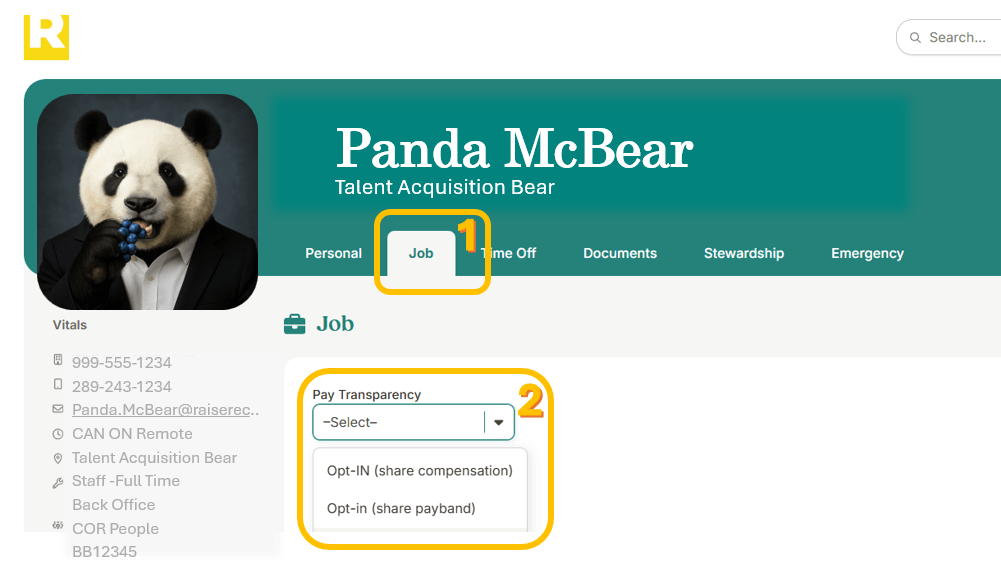
Where do I ‘Opt-in’? You can Opt-in on the Job tab of your BambooHR profile
Why are we encouraging Pay Transparency?
If sharing your compensation or learning about your colleagues’ compensation feels uncomfortable, you’re not alone, and that reaction is completely understandable. Most of us grew up in a world where salary was treated as deeply personal information, almost taboo. Read on to understand how we got there and why self-managed organizations like Raise are taking a different approach.
The Industrial Era and the Birth of Wage Secrecy
The norm of private compensation took shape in the early 20th century, driven by a specific set of conditions:
- Employers discovered that keeping wages secret made it easier to pay different workers different amounts for the same work. Without shared information, employees could not easily challenge gaps.
- Company hierarchy depended on information asymmetry. Managers knew more than workers. Secrecy was one tool that reinforced this power structure.
- In the 1930s, some U.S. corporations began including explicit clauses in employment contracts prohibiting employees from discussing their pay, what we now call “pay secrecy” clauses. This became common practice for decades.
The Cultural Reinforcement
Over time, the policy became a social norm. Discussing money came to feel rude or aggressive, especially in professional settings. This cultural conditioning served employers well: workers who feel embarrassed to ask “what are you making?” are workers who don’t compare notes.
The norm was also uneven. Research consistently shows that pay secrecy disproportionately harms women, racialized workers, and newcomers to a field, groups who are already less likely to negotiate aggressively and who benefit most from market information. *Worth knowing
In Canada and the United States, employees have a legal right to discuss their wages with each other. Pay secrecy policies in employment contracts are generally unenforceable and, in some jurisdictions, explicitly illegal. The discomfort around salary talk is cultural — not legal.
The Core Philosophy
In a traditional hierarchy, compensation decisions happen in a room most people never enter. A manager or HR team sets a number, and the employee either accepts it or tries to negotiate in the dark. The process depends on information the employee doesn’t have.
Self-managed organizations take a different starting assumption: the people closest to the work are often best positioned to make decisions about the work — including decisions about compensation. But good decisions require good information. Transparency is the infrastructure that makes peer-advised compensation possible.
Key Benefits of Open Compensation
1. It surfaces and reduces bias
When pay is visible, patterns become visible. Unexplained gaps between comparable roles, whether due to gender, race, tenure, or negotiating style, are much harder to sustain. Research from organizations that have adopted transparency consistently shows a narrowing of unjustified pay gaps over time.
2. It builds trust in the process
Secrecy signals that there is something to hide. Transparency signals that the process can withstand scrutiny. When people can see how compensation is determined, they can evaluate whether it’s fair, and they can trust it more when they believe it is.
3. It replaces politics with process
In opaque systems, people optimize for the relationship with the person who controls their salary. In transparent systems, compensation is tied to visible criteria and advised by peers, not the outcome of private lobbying. This shifts energy from managing up to doing good work.
4. It makes the advice you give meaningful
In the RaiseOS Compensation Alignment Process, you are asked to advise on whether someone’s proposed compensation is appropriate. You cannot meaningfully answer that question without context. Knowing what your colleagues earn is not gossip, it is the data you need to give honest, useful advice.
5. It removes the negotiation penalty
In closed systems, compensation often reflects how well someone negotiates rather than the value they contribute. Research shows that women in particular are penalized for negotiating assertively. Transparent, process-based compensation reduces how much individual negotiation style affects outcomes.