

Wandering Worker Consent Process

Steward: Cassandra Sturk & Meaghan Nowicki
*Do not schedule travel until your WWCP is completed*

The Freedom: At Raise, most of us are fully remote and not required to be in a physical office every day and could technically work anywhere with an internet connection.  

The Responsibility: You also have the responsibility to ensure that you’re working legally and compliantly wherever you’re physically working from.

Every person is set up with their home address as their default work location – and this setup drives legal, tax, insurance and security components of your employment with Raise.  

The purpose of this practice is to provide guidance for employees who want to travel outside their default work location while working, also known as ‘Digital Nomads’ or ‘Wandering Workers’. Read this practice carefully to fully understand what information you’re required to gather and share, as well as who you should seek advice from to ensure you’ve met the requirements to travel and work, before you solidify your travel plans.

  • Unless there is a business reason for you to work outside of your default work location, travel with intention of working is a personal choice, therefore the onus is on the ‘Wandering Worker’ to ensure it is done safely and legally.  
  • If you’re considering moving (whether short-term or permanently) to a country outside your default work location, regardless of the length of time, you’ll need to consult an immigration lawyer. 

Start your Loomio Proposal 1-2 months before your anticipated travel. Do not schedule travel until your WWCP is completed and has been consented to. If you’re not eligible to work remotely in the country you’re travelling to, and your stay exceeds 2 weeks, proceed with a regular WAAP to gather advice.

1. Select a Peer Mentor. Schedule a meeting with them once you’ve answered all questions in Step 1.

2. Are you legally eligible to work in the country you’re travelling to?  

Do you require a visa to travel to or work remotely in the country of destination? 

(If it’s a “grey area” and your visa or the country of destination does not explicitly state that wandering workers or digit nomads are permissible pause/stop your WWCP. Grey is not okay!

These are the three acceptable answers: 

a). “No, a visa is not required, and I’m allowed to work remotely, as a digital nomad” –Provide official evidence or documentation from the government website, or documentation about your working eligibility/status for your destination country.

b). “Yes, a visa is required, but I’m eligible to work remotely on a visa” Share what visa you require and evidence/documentation from a government website from the country of your destination. 

c).  I sought advice from an immigration lawyer, and I have clarified my eligibility to work in this country – Provide documentation to support this.  

3. Share your documents with the HR & Compliance people invited to your Loomio post. (If a visa is required, apply for it in advance of starting/posting your Loomio.)
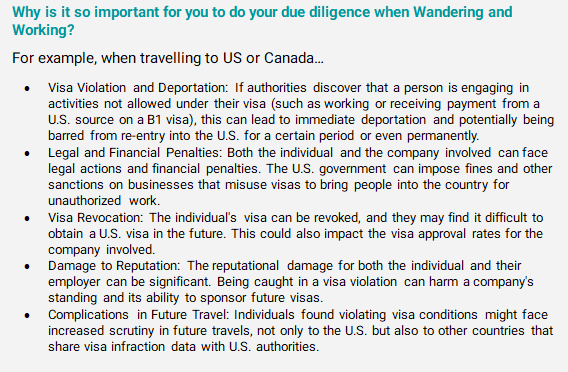
4. What country are you travelling to?  

5. How many days have you been outside your home country in the last 365 days?

(Both Canada and the United States require you must be in your country of residence at least 185 days within a rolling calendar year) 

6. What is your planned travel date?  

7. When will you return home? 

8. If you need coverage for your role for part of your travels, who is your back up?
Reference the
WAAP questions and detail your plan. 

9. Health Benefits:

  • Confirm that the duration of travel does not impact your Health Insurance Plan or Medical Health Benefits in your home country (For example, in Ontario, if you are out of the province for more than 6 months, your provincial health insurance will be impacted, which will impact your Group Health Benefits and your Travel Insurance). 

10. Travel Insurance: 

  • Canada & United States – Call and confirm your Travel Insurance is valid in your country of destination. 
  • Ghana, India, Peru & Philippines – Provide proof of travel insurance for your country of destination and duration of your travels. 

11. Tax Implications: 

  • Canada & United States – Are there any tax implications (CRA, IRS or country of destination) due to the duration of your travels? 
  • Ghana, India, Peru & Philippines – Will your travels impact your taxes in your home country or country of destination? 

12. Canada & US Employees:
Email Compliance@raiserecruiting.com confirm with your state or provincial worker’s compensation will still cover you while working in your country of destination.

Your Loomio post should also include all relevant information and answers from Step1 as well as explicit acknowledgement of the following: 
  • My employment remains subject to (insert home country) law. 
  • I do not acquire rights under (insert country of destination) employment law. 
  • This short-term remote work arrangement is a personal request, and I agree to ensure compliance with any local laws, taxes, or obligations while working remotely. 
  • All costs incurred are my responsibility (i.e. internet, phone etc, travel or work visa’s etc) 
  • All research & investigation is my responsibility, the ‘Wandering Worker’ (if not done correctly it can affect our business i.e., visa programs or eligibility) 
  • Include written advice/documentation from an immigration lawyer or local government authority if you’re moving to a country outside your default location that you can work remotely from that country through a foreign employer 
  • Outline your Loomio Proposal timeline with something like: “I hope to speak with or gather advice from all my advisors by XYZ date, make a proposal on XYZ, wrapping up my decision by XYZ” 
Once you’ve completed all your research and have created your Loomio post, in addition to any relevant team members, including anyone providing coverage for your role, please invite someone from the following teams: 
 
  • IT – Discuss with our IT teams your working situation and country of destination, include IT team in WWCP (email helpdesk@raiserecruiting.com 
  • HR – Ask a member of the HR team to advise on your WWCP (if travelling internationally, please include one Offshore and one North American HR member to advise on your WWCP.  
After completing Step 1, consulting your advisors, and demonstrating your ability to meet all outlined requirements, you can proceed to draft your proposal and formally request consent. Ensure your proposal is clear, addresses any concerns, and highlights your readiness to move forward. Once consent is granted, finalize your plans by booking travel and making the necessary arrangements. 

Question:
I saw Jane working on vacation, so I can too, right?

Answer:
Not necessarily. Jane may have completed a WWCP, or have different citizenship status, visas, or have a different employment status (ie, be an Independent Contractor). You don’t know other people’s circumstances, so it’s best not to assume or compare.


Question:
I can’t find official documentation on a government website, but travel blogs say it’s generally acceptable, is that good enough? 

Answer:
No, the company can consent to you working somewhere unless it’s explicitly legal and compliant for you to do so.


Question:
Can I check my email while on holiday?

Answer:
Yes, checking your email or shooting off a quick message is considered ‘incidental work’, and generally acceptable.


Question:
What if I can’t get the right visa or documentation in place for my trip?

Answer:
Then you shouldn’t work while you’re on your trip. You can check your emails or answer a brief call, but you shouldn’t have any planned work days or activities.